Linked Horizon Wall Primary
Radius 2,048, three blocks thick, bedrock to build limit, 8.26 million obsidian, 125 days, 100+ builders, started by OMEGAO000. The single most cited figure in the video.
Video source notes
The answer is arithmetic, and the arithmetic is built from wiki-documented block counts. Where we did the sum ourselves, we say so.
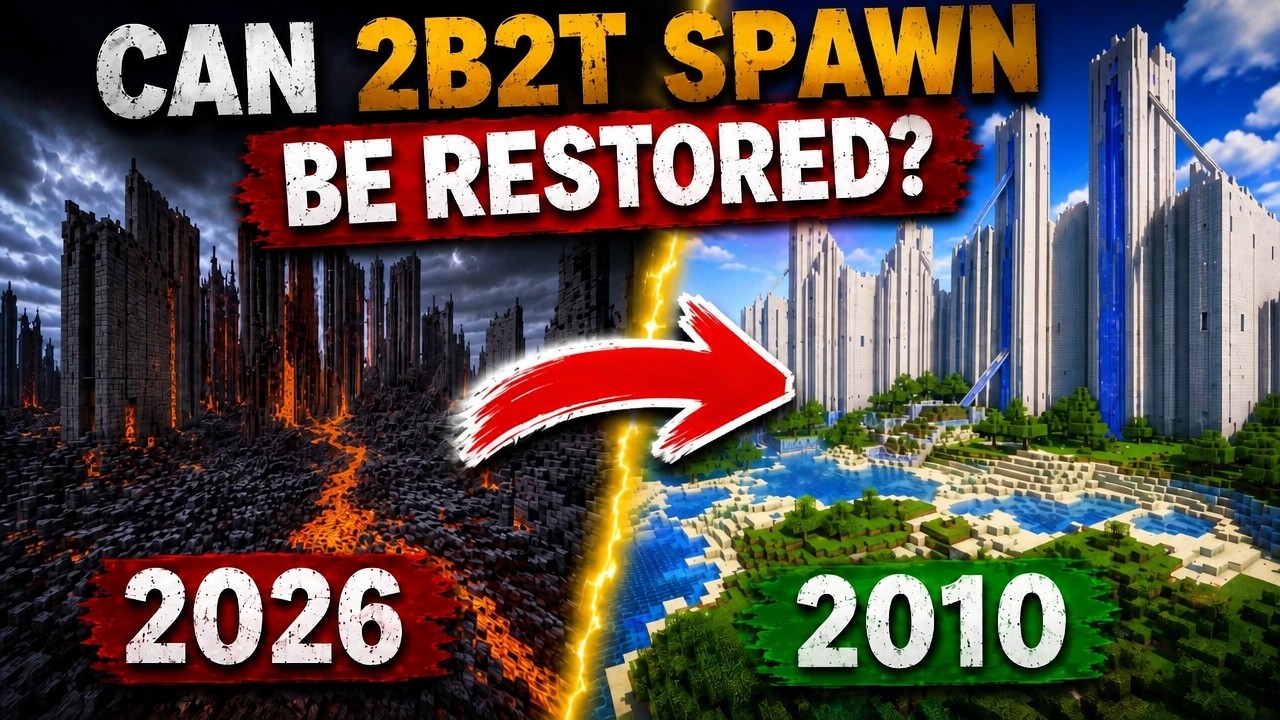
What is actually there
The core idea
The Linked Horizon Wall is the load-bearing artifact in this story: a circular obsidian wall of radius 2,048 around spawn, built bedrock-to-build-limit and three blocks thick, completed in 125 days by over a hundred players placing 8.26 million blocks. It is documented, dated and attributed. The obsidian roof laid over spawn sits on top of that.
In autumn 2020 the Infinity Incursion built a water cube 1,000 by 1,000 blocks with the stated goal of making spawn harder to escape; it took roughly a month and a half and produced over 250 million water source blocks. Water cannot be deleted, only absorbed, and a sponge holds 65 blocks before it needs drying.
“The wasteland is not a problem to the veterans. It is a filter.”
The hour figures in the video are ours, not the wiki’s. Obsidian mined with a maxed netherite pickaxe under haste takes roughly 1.85 seconds a block; applied to the wall and roof together that is thousands of player-hours before anyone accounts for lag, transport, storage or the fact that other players will be actively stopping you. The arithmetic is stated on screen as arithmetic.
The social half is better documented than the technical half. Team Uberslugcake formed in January 2014 to clear lavacasts and build farms near spawn and was destroyed in April 2016 when a backdoor compromised their bases. TeamNoTrees was created in November 2019 to strip trees and dirt out to 10,000 blocks, and cleared its first phase in four days. Nocom, found in 2018 and patched in 2021, let one group watch the coordinates of essentially everyone — which is why a restoration team could never keep a supply base hidden.
Primary sources
Radius 2,048, three blocks thick, bedrock to build limit, 8.26 million obsidian, 125 days, 100+ builders, started by OMEGAO000. The single most cited figure in the video.
The obsidian layer placed over spawn to keep it dark, and the second half of the obsidian total.
Autumn 2020, 1000×1000, over 250 million water source blocks, roughly six weeks of work, with a program written to verify which blocks were true sources.
The overview page for the spawn region: what is there, and how it accumulated.
Current queue, player count, version and world size — for checking any figure here against today.
Every attempt, and why it failed
Established 5 January 2014; spent months destroying lavacasts and building farms near spawn; destroyed in April 2016 when a backdoor compromised the group’s bases. The first major attempt to fix spawn.
Created 25 November 2019 to remove all trees and dirt from 0,0 out to 10,000 blocks in every direction. Phase 1 completed in four days.
Formed June 2016 against the Rusher influx, ended October 2016 — the conflict during which the Valley of Wheat was griefed.
Coordinate exploit found in 2018 and patched in July 2021; allowed one group to observe player positions server-wide. The reason no restoration effort could stay hidden.
Write-up putting numbers on the fallout — thousands of players affected, 15,000+ bases located, and the databases built from it.
The group’s own technical write-up of the exploit.
Scale of the world
Reporting on the community effort that compressed the map to a 15 TB download, and the ~80 TB figure it started from. Relevant because the world-size number is quoted differently across sources.
General reference for the December 2010 start date and the server’s continuous operation.
Hardness 50 and mining times — the input to the hour arithmetic in the video.
The 65-block absorption limit behind the water-removal figures.
Conflict log · what the sources dispute
Two claims in the video could not be verified against any source we could reach, and one number is quoted three different ways across the community.
| Claim | What the video says | What the sources say | Position |
|---|---|---|---|
| World size | “over 100 terabytes” | reporting on the archive project works from ~80 TB; the compressed download is 15 TB | Order of magnitude is right, the exact figure is not settled. Treat as “tens of terabytes and growing”. |
| The 2019 restoration initiative | a group proposing replanting and housing, mocked off the server | no wiki or archive we could reach documents it under that name | Could not verify. Flagged here rather than defended. |
| Team Trees vs Team No Trees | Team Trees came first, No Trees was the counter-movement | the wiki has TeamNoTrees created 25 Nov 2019 and TeamTrees created to combat it | Order is disputed. Both groups existed in late 2019; who reacted to whom is unresolved. |
| Mining-hour totals | 6,400+ player-hours for the wall and roof | the wikis publish block counts, not hour totals | Our arithmetic, from documented block counts and vanilla mining speed. Stated as a calculation. |
| Unique players | over 1 million | 1,021,812 as of May 2026 | Confirmed. |
The wikis used here are community-maintained. Block counts for the wall and the water cube are consistent across more than one wiki and are treated as reliable; group-history dates are single-source and are treated as corroboration.